It’s the first paradox of laboratory design: the smaller the particles that scientists want to study, the bigger the structures needed to house them. The world-famous Cavendish Laboratory in Cambridge is at the forefront of quantum science, exploring the sub-atomic world in order to unlock the secrets of dark matter and the origins of life itself. It’s where Ernest Rutherford split the atom and Crick and Watson decoded DNA.
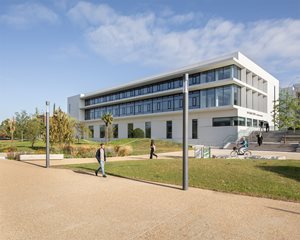
The Cavendish’s new home, however, is at the other end of the physical scale. Designed by Jestico + Whiles, the Ray Dolby Centre occupies a huge plot of land on the Cambridge West Innovation District. Its main frontage stretches for 175m – roughly the length of two football pitches. Turn the corner and it’s another 100m walk to the back of the building.
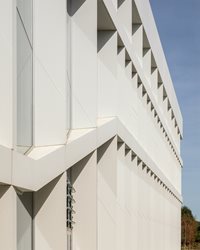
The whole thing is wrapped in polished white precast concrete: a rhythmic procession of loadbearing fins in front of the glazed entrance facade, and panels up to 8m x 8m on the side elevations (see box, below). “The concrete finishes really came from the brief,” says Jude Harris, director at Jestico + Whiles. “The philosophy behind it was always to make it seem like a timeless building.”
The huge footprint generates an internal floor area of 33,000m2 over five levels, housing facilities for 1,100 staff and student. As well as laboratories, these include 260 offices, 16 workshops, six large courtyards, a cafe and library. Visitors enter via a wide, processional stair that leads up to an entrance plaza and on to the first- floor reception, a double-height space dominated by two huge bronze scale-clad lecture theatres. Unusually for such a sensitive research facility, the front of the building is almost entirely open to the public. Anyone can walk downstairs to the ground-floor library, or wend their way up to the top-floor cafe.
But most of all, this is a building devoted to highly specialised lab space. “There are 172 labs, all of which are bespoke,” says Marie Chuet, project director for main contractor Bouygues UK. “They all have different specifications. Some of them have very, very high vibration resistance. Some have very strict temperature control, to just 0.1˚C. Some are clean rooms where the air is highly filtered.” Other areas needed to be completely non-magnetic, requiring the use of non-ferrous stainless steel reinforcement in the slabs and walls. Some of the equipment is so delicate and finely tuned that areas of road had to be resurfaced to minimise vibrations.
The most controlled environments are in the basement, where a raft slab with a thickness of up to 3m has reduced vibration frequencies to a level more than 100 lower than a hospital operating theatre (see box, below). But with nearly 7,000m2 of labs to accommodate, the architects have had to place highly sensitive equipment throughout the building. At the same time, these spaces needed to be extremely flexible – a theme that emerged consistently from the in-depth interviews that the design team carried out with the Cavendish physicists.
“Every lab will change on average every seven years,” says Lynden Spencer-Allen, director at structural engineer Ramboll, and a specialist in the design of laboratory buildings. “And the science that they’re doing in 15 years could be extremely different to what they’re doing now.” Such exacting criteria could best be achieved with an in-situ reinforced- concrete frame of flat slabs and columns, says Spencer-Allen. “It’s the mass, the stiffness, the flexibility of the slabs.”
The typical structural grid throughout the building is a relatively small 6.8 x 7.2m, but this ensures that the frame remains rigid, so labs can be located on higher levels. The flat slabs allow services to be reconfigured without the risk of running into downstand beams. Upper floor slabs are typically 300mm deep, but this rises to 475mm in areas where vibration control is critical, and 700mm for the ground-floor slab. Spencer- Allen points out that the short spans ensure the floorplates are as material-efficient as possible. A 50% GGBS mix in the slabs also helps to reduce the carbon impact – a crucial factor for the university, which is aiming to reduce its carbon emissions by 72% between 2016 and 2030.
The Dolby Centre may look like one enormous building, but it is actually nine independent structures. “The challenge was that we’ve got super-sensitive equipment and also equipment that produces a lot of vibrations, so separation is our friend,” says Spencer-Allen. The building is divided into four parallel wings, each 28m wide, with the public zone in front.
Each of the four wings has its own central utility building (CUB) – a lightweight four-storey volume that is plugged into the back of the building like a power pack, but structurally isolated with a movement joint. The CUBs feed each wing laterally across the soffits, with pipes and ductwork semi-hidden behind mesh ceiling panels. There are no vertical risers, which again helps to reconfigure space. The ceiling panels are hinged for easy access, and the deep voids have been designed with spare capacity.
LET IT SHINE
 Cladding the Cavendish
One of the most striking aspects of the Ray Dolby Centre is its almost gleaming white precast concrete
facade. “We worked closely with Jestico + Whiles to achieve that polished finish,” says Bouygues UK’s Marie Chuet. The first panels were installed almost five years ago, and are still impressively white – a product of their fine white marble aggregate, white cement and five different grades of polishing: “The elements don’t really stick to it.”
In order to define the finish and establish a benchmark, the team built an 8m-high mock-up. “It was a two-storey cube, which allowed us to finalise the interfaces, connections and lifting details, and get validation from all the stakeholders – the architects, the university, the planning officers. Everybody was really interested in that finish.”
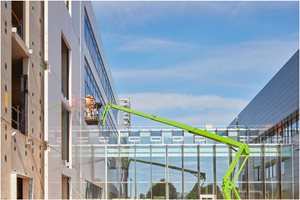 The lifting details were of particular importance. In keeping with the scale of the building, the largest panels are 8m x 8m and weigh about nine tonnes. “Every move of every panel had a method statement,” says Chuet. Some required two cranes to lift them into place.
In total, the facade comprises 1,000 panels, with 200 different sizes. “We have the fins that clad the columns, horizontal elements that act as brise- soleils, and big internal panels with cutouts for lift buttons. Every single one of them was uniquely poured and uniquely labelled.”
It is perhaps unavoidable that basement labs – windowless and sterile – have a dystopian feel. But this made it all the more important that the rest of building should feel open and connected, says Harris. “We wanted to put science on show. No one in this building should feel hidden away.”
The public zone is a light-filled space, with fair-faced concrete walls and slender cylindrical columns. Various types of formwork were trialled, including marine plywood, phenolic-coated plywood and cardboard. The chosen system for the walls comprised metal shutters coated with vegetable oil, leaving a smooth finish, while the columns were cast using cardboard sleeves. The architects and contractor worked closely to benchmark the finishes, tie holes and joints – particularly the connections at the base of the walls, which have no visible kicker.
The bronze lecture theatres are both suspended from the frame. The smaller of the two, which hangs over the reception desk, is a lightweight structure, its weight carried to the ground via columns embedded in the precast fins on the main elevation. The larger 400-seat hall was cast in situ. The loads are transferred over the hall to the perimeter via 1.5m transfer beams, leaving the theatre largely column-free.
A FORCE TO BE RECKONED WITH
How to build a non-magnetic reinforced concrete structure
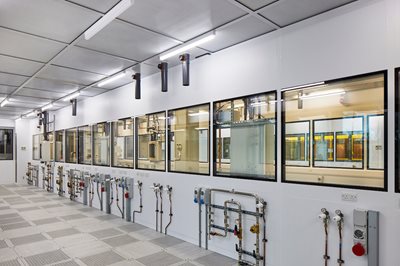 A cryostat is a specialised cooling system that allows experiments to be carried out in temperatures as low as 150˚C and without magnetic interference. This posed a challenge for Bouygues UK during the construction of the ground- floor cryostat hall: how do you build a vibration- sensitive concrete structure without magnetic steel reinforcement in the slabs and walls?
“We initially thought we could coat the rebar in epoxy,” says Bouygues’ Marie Chuet, “but we carried out some tests with the Physics department professors and they said, ‘Nope, not good enough’.” The only option that would not disrupt the scientists’ work was a very specific grade of “austenitic” stainless steel, with high levels of nickel and chromium which alter its crystal structure. “The ties had to be stainless steel too, as even these would show up on the readings,” adds Chuet.
The properties of austenitic stainless steel differ crucially in a number of areas. “It is not as ductile as normal steel, so it doesn’t react to bending tools in the same way.” Moreover, its magnetic strength can actually increase if it is bent or welded in the wrong way. The manufacture of the reinforcement was therefore a highly specialist task, requiring initial fabrication in Italy, then shaping at a specialist facility in Ireland. From there, it was delivered to site, where it was assembled and the physicists tested the magnetic fields one last time before the walls and slab were finally poured.
Behind the public zone, the above-ground workspaces are easily navigable and connected to the outside world. A simple circuit of 3m-wide corridors – enough space to move laser tables and gas tanks between labs – wraps around the four wings, each ending with a full-length window so there are no dead-ends. The wings are separated by three large courtyards, landscaped with gentle mounds to create sufficient soil depth for small trees to grow. At third floor level, three more smaller courtyards are cut into the plan, so all the offices have external windows. In total, the building contains 3,000m2 of outdoor space, assisting with orientation and drawing daylight deep into the plan. While the courtyards are used to generate visual connections, they’re part of the separation strategy too.
The central courtyard sits above a concealed interstitial floor that serves the basement clean rooms, while another acts as a buffer zone for the electromagnetic fields emanating from the labs below. The upper-level courtyards also help to naturally ventilate the offices. Windows facing into the courtyards can be left open overnight, purging the heat built up during the daytime. The soffits and other exposed areas of the concrete frame contribute to this passive approach, acting as a sink for heat or coolth, depending on the season.
As you might expect from a building with some of the tightest temperature controls in the UK, the Dolby Centre is highly serviced, with a peak energy load of 220W/m2. But the designers have worked hard to mitigate consumption and earn a BREEAM Excellent rating. As well as natural ventilation to the offices and workshops, a ground-source heat pump, sustained by a 20,000m2 network of boreholes, provides all of the heating for both the Dolby Centre and the neighbouring West Hub (CQ 280, Autumn 2022).
The linear park between the two buildings is maturing into a welcoming green space amid the temples of science – Chuet points out that 107 trees have been planted during the project. Even during this summer’s heatwaves, the plants are thriving and scientists have been lured from their labs to grab a coffee and loll on deckchairs. It’s beginning to feel like a part of the city. That’s the second paradox of laboratory design: the bigger these facilities get, the more human they become.
UNSHAKEABLE
Designing and building the UK’s most solid slab
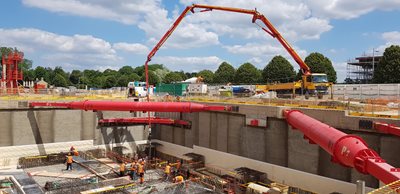 The basement of the Ray Dolby Centre has a good claim to being the most immoveable object in the UK, with a vibration rating of VC-H. To put this in context, vibration levels are measured on an exponential scale: VC-A refers to movement of 0.001mm per second (suitable for a general- use laboratory), VC-B is twice as low again, and so on. Most highly sensitive labs – such as the clean rooms at the National Graphene Institute in Manchester – are VC-D or E rated. VC-H is eight times lower even than that.
The key to this completely motionless state is the 50m x 30m basement raft, the eastern half of which is 2m thick, with some key areas as deep as 3m. Structural engineer Ramboll knew that if it got this slab wrong, the highly specialised microscopy labs above would fail to perform as specified. In a project with a £300m pricetag, that put quite a lot of pressure on their calculations.
Ramboll took borehole readings at 2m intervals down to 10m in order to understand the vibration profile of the
site – a former meadow on a 25m-deep layer of Cambridge Gault clay. There were a number of concerns, including traffic along the nearby M11. The origins of a persistent spike in the measurements was found to be a speed hump on a bus lane, which had to be removed. The survey found that a depth of 8m was the sweet spot, with ground-level vibrations having dissipated. “Any deeper than that and you start to get diminishing returns.”
Although a 2m-thick raft might sound like a lot of concrete, Spencer-Allen points out that it’s more material- efficient than a piled option. The vibration analysis also enabled the team to optimise the depth of the slab, which slims to 1m beneath less sensitive zones. A 10m2 test slab was poured, 8m deep, under what would become the entrance plaza. “That gave us the proof of concept,” says Spencer-Allen.
 A testing regime was devised alongside the University of Southampton so that vibration could be continuously monitored throughout the project. Pouring the basement slab brought challenges of its own. “The biggest risk was that cracks would develop because of the thickness of the slab,” says Vlad Balanescu, civils project manager at Bouygues UK. “Even micro cracks can allow vibrations to pass inside the building.”
A special mix was developed with 70% GGBS to allow the concrete to cure more slowly, and throughout the curing period, sensors closely monitored the difference between the core and bottom of the slab. “We installed tubes in the thickest parts of the slab to circulate cold water, and added ice to the concrete. When the ice company arrived, they thought it was for a pool party. They were a bit surprised.”